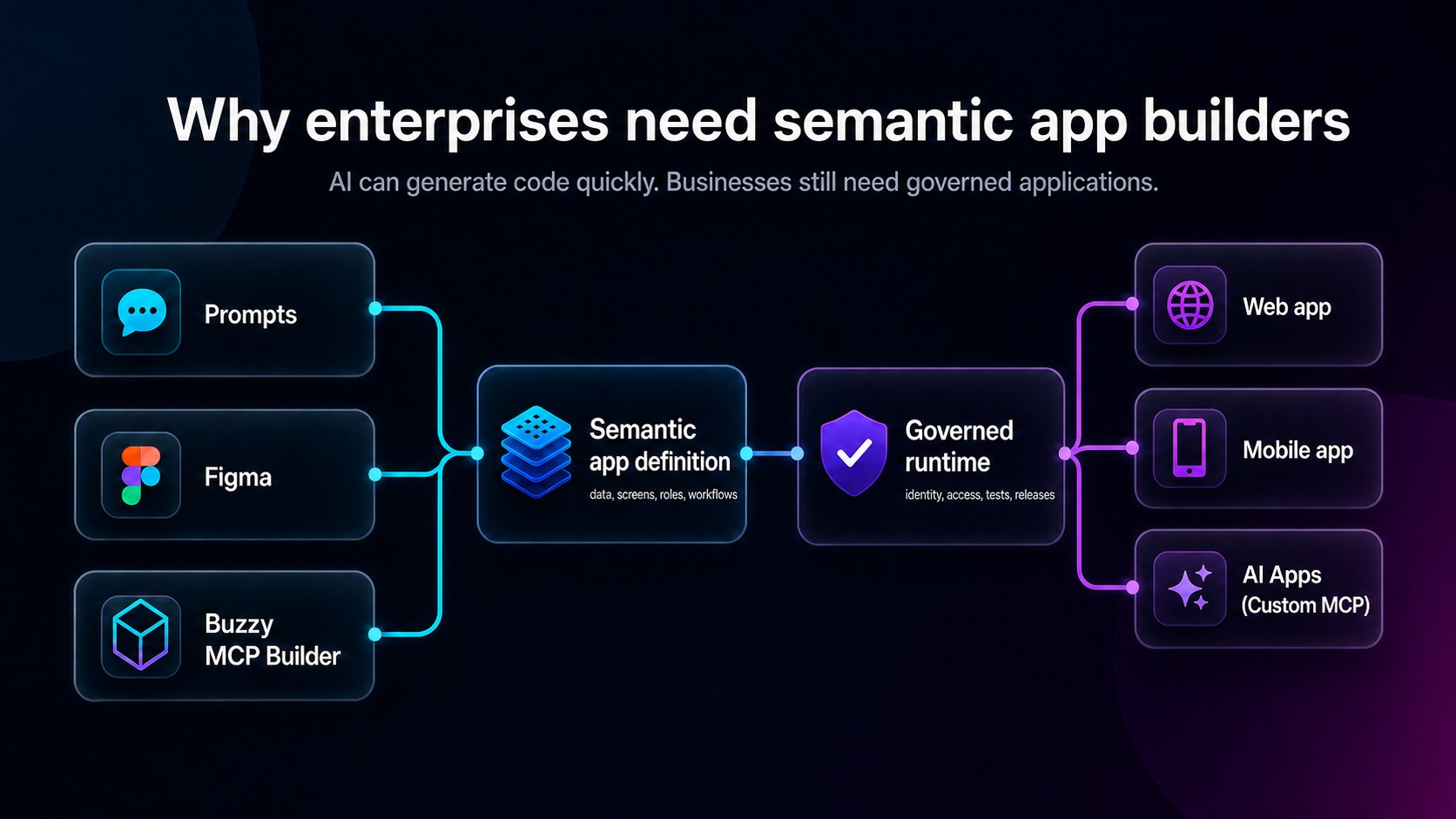
AI has changed the software conversation.
For the first time, the bottleneck is no longer simply “who can write the code?” Anyone with a clear enough idea can prompt an AI tool and get something back that looks like an application. Developers can move faster. Product teams can prototype faster. Non-technical people can participate in creation in a way that was not possible before.
And the productivity gains are real. In a controlled GitHub Copilot study, developers using Copilot completed a programming task 55.8% faster than those who did not. (Microsoft) Gartner has also predicted that by 2028, 75% of enterprise software engineers will use AI code assistants, up from less than 10% in early 2023. (Gartner) This is not a fringe movement. It is becoming the default direction of software development.
The pressure is also coming from the top. Deloitte’s State of Generative AI report found that three-quarters of business and technology leaders expect generative AI to transform their organisations within three years, while only around a quarter felt highly prepared to address governance and risk. Deloitte’s CEO put it well: the “speed, scale, and use cases for GenAI are breathtaking,” but leaders are under immense pressure to realise value while managing risk. (Deloitte)
So enterprises have a problem.
They cannot afford to ignore AI coding. But they also cannot afford to let hundreds of people generate hundreds of disconnected, ungoverned applications and call that an enterprise software strategy.
That is why I think every enterprise should build, buy, or adopt a semantic app builder.
And yes, that is exactly why we built Buzzy.
AI coding is great at generating code. Enterprises need applications.
There is an important distinction that often gets lost in the excitement.
AI coding tools are very good at generating code. But enterprises do not run “code.” They run systems.
A real enterprise application needs more than screens and functions. It needs a data model, authentication, permissions, integrations, workflows, audit trails, privacy rules, testing, monitoring, deployment processes, support processes, upgrade paths, and compliance boundaries.
The person prompting the application may not think about all of that. They may not know what they do not know. They may describe the happy path, but not the exception paths. They may specify the user interface, but not the security model. They may define the workflow, but not the lifecycle.
So the AI fills in the gaps.
That is both the magic and the danger.
When AI fills in missing requirements, it does not just generate code. It makes architectural assumptions. It chooses libraries. It creates patterns. It decides how data moves. It invents error handling. It may create tests that pass because they reflect the same misunderstanding as the original prompt.
The output can look impressive, but the question remains: does it actually do what the organisation needs it to do?
That question becomes much harder when the only way to answer it is to read every generated file, inspect every dependency, validate every security decision, and reverse-engineer the architecture after the fact.
The enterprise risk is not one AI-generated app. It is fifty.
One AI-generated application is manageable. You can review it. You can harden it. You can refactor it. You can put guardrails around it.
But that is not where this is heading.
The real enterprise risk is what happens when every team can create software at speed. Sales wants a CRM workflow app. Operations wants a warehouse dashboard. HR wants an onboarding tool. Finance wants a compliance tracker. Support wants an internal triage system. Someone builds a customer portal. Someone else builds a mobile field app.
Suddenly you do not have one AI-generated codebase.
You have five. Then ten. Then fifty.
Each one has its own assumptions, dependencies, framework choices, styling conventions, security model, data access rules, deployment process, and maintenance burden. Even if every app was “working” at launch, the organisation has created a new kind of technical debt: AI-generated application sprawl.
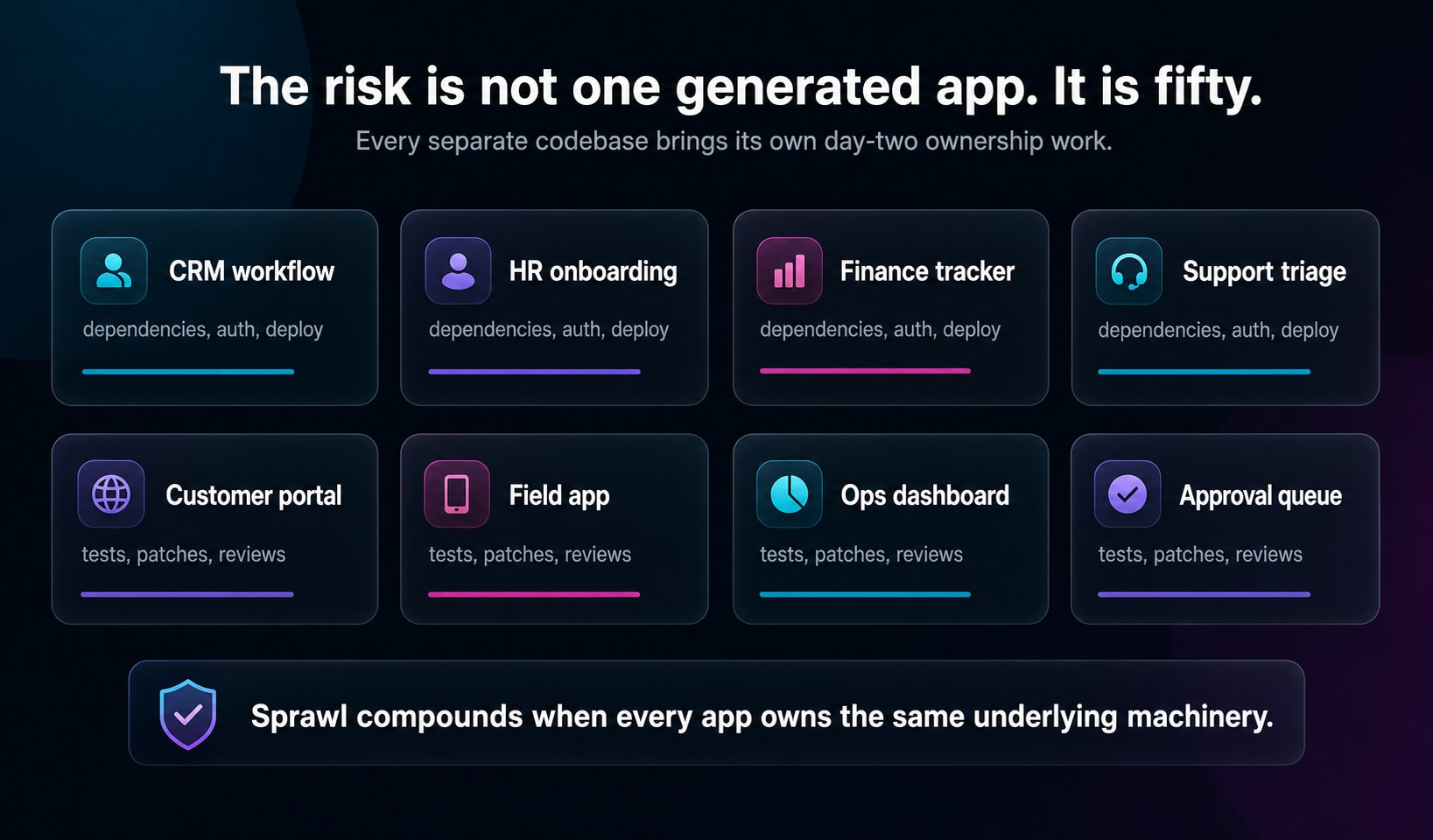
This is where the economics start to break.
Stripe’s Developer Coefficient research found that developers spend more than 17 hours per week dealing with maintenance issues such as debugging, refactoring, and bad code, with bad code alone representing an estimated $85 billion annual opportunity cost globally. AI does not magically remove this maintenance burden. In many cases, it accelerates the creation of code that still needs to be understood, tested, secured, upgraded, and governed. (The Developer Coefficient)
And developers themselves are cautious. In the 2025 Stack Overflow Developer Survey, 46% of developers said they actively distrust the accuracy of AI tools, compared with 33% who trust them. Only 3.1% reported high trust. (Stack Overflow Insights) That is not because developers are anti-AI. It is because they understand what production software requires.
Security is another problem. Veracode’s 2025 research found that 45% of AI-generated code contained security flaws, based on testing more than 100 large language models across 80 coding tasks. (Veracode) Again, the issue is not whether AI can generate useful code. It can. The issue is whether an enterprise can safely govern the volume of code being generated.
We are already seeing warning signs. A Replit AI agent reportedly deleted SaaStr’s production database, including 1,206 executive records and 1,196 company records. (Business Insider) A security review of Lovable-built projects found 303 exposed endpoints across 170 projects with inadequate row-level security settings. (Matt's Website) In another case, Claude Code used with Terraform reportedly wiped production infrastructure, including a database holding 2.5 years of records and the recovery snapshots. (Tom's Hardware)
The lesson is not “do not use AI.” The lesson is that once AI moves from mockups to production systems, governance becomes the product.
The old software principles still matter
The funny thing is that the answer is not entirely new.
Good software teams have always known the value of abstraction, reuse, separation of concerns, and DRY — Don’t Repeat Yourself. If you see the same thing being built again and again, you abstract it. If multiple teams need the same capability, you turn it into a shared service. If every application needs authentication, logging, permissions, deployment, and upgrades, you do not want every team solving those problems from scratch.
Gartner’s work on platform engineering points in the same direction. Gartner predicted that by 2026, 80% of software engineering organisations will establish platform teams as internal providers of reusable services, components, and tools for application delivery. (Gartner)
That is the right instinct.
But AI coding pushes the idea further.
If AI can generate applications at massive speed, then the enterprise needs more than reusable components. It needs a reusable application runtime. It needs a way to separate the definition of the application from the code that executes it.
That is where the semantic app layer comes in.
The semantic app layer: define the application, centralise the code
A semantic app builder changes the unit of creation.
Instead of asking AI to generate a large, bespoke codebase for every application, the AI generates a structured semantic application definition.
That definition describes what the application is:
the data model
the screens and components
the workflows
the business logic
the permissions and security rules
the integrations
the privacy and governance requirements
Then a common runtime — a core engine — turns that definition into a working application.
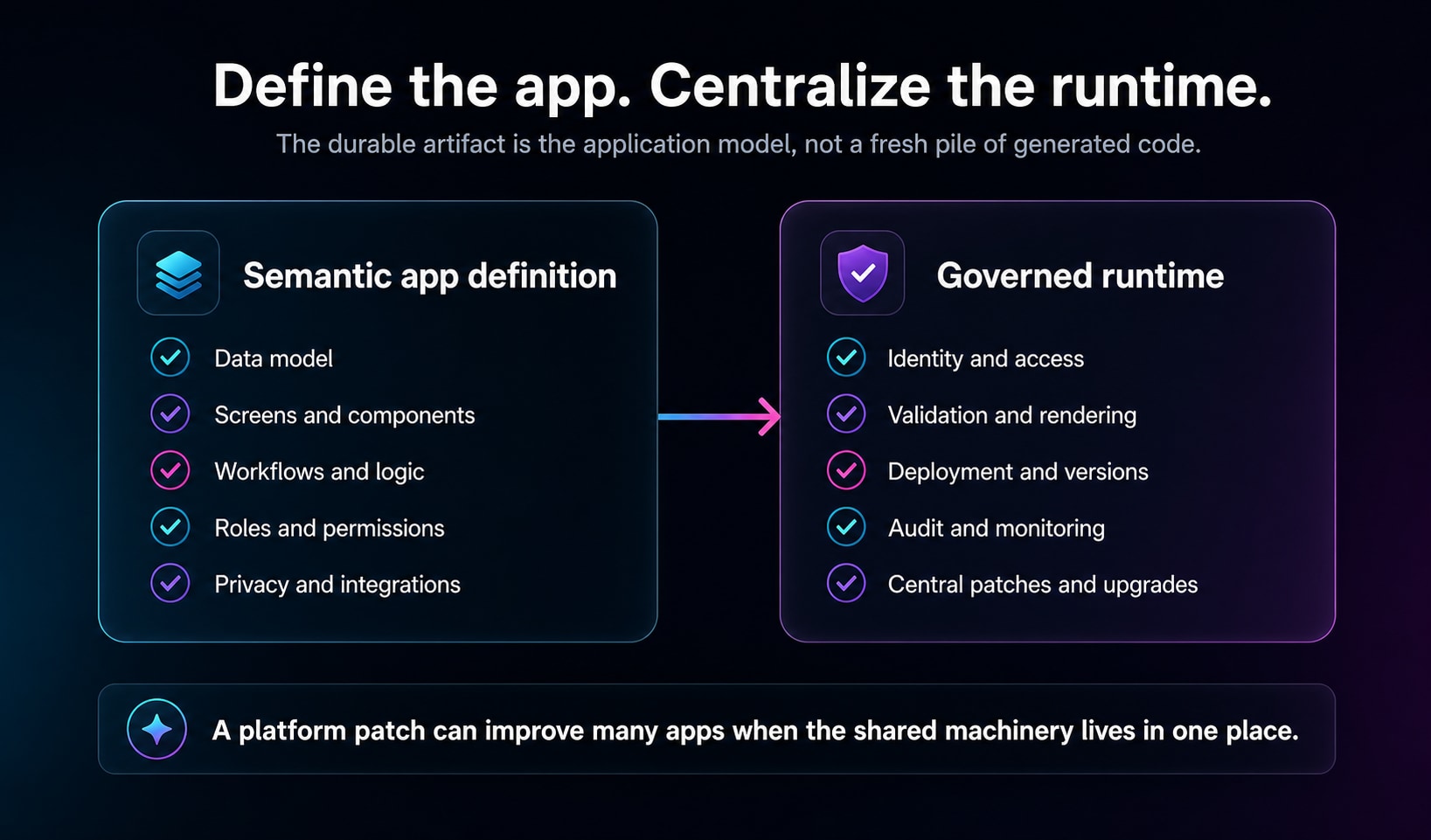
Think of it like a recipe and a kitchen.
The semantic app definition is the recipe. It says what needs to be made. The runtime is the kitchen. It knows how to prepare, enforce, serve, scale, secure, and update the result.
This matters because most enterprise applications share a huge amount of underlying machinery. They need identity, data access, forms, validation, workflow, notifications, APIs, reporting, auditability, deployment, versioning, and UI rendering. If every AI-generated app recreates those things separately, you get sprawl. If those capabilities live in a shared runtime, you get leverage.
Now a security patch can be applied once. A platform upgrade can benefit every app. A new feature can become available across the portfolio. Compliance review can focus more on the underlying platform and the application-specific rules, rather than every line of every generated codebase.
That is the shift: from AI-generated codebases to AI-generated application definitions running on trusted core code.
Why this is the enterprise control point
The enterprise does not need to stop people from creating applications with AI. That would be the wrong move. The productivity upside is too large, and the competitive pressure is too strong.
But the enterprise does need to control where the complexity lives.
If the complexity lives in hundreds of generated codebases, the organisation inherits hundreds of maintenance problems.
If the complexity lives in a governed runtime, and each application is represented as a semantic definition, the organisation gets a much better control point.
This is the same reason platforms beat one-off projects. It is the same reason cloud platforms beat hand-rolled infrastructure. It is the same reason design systems beat bespoke UI. It is the same reason internal developer platforms are becoming strategic.
The enterprise does not just need more apps.
It needs a governed way to create, run, maintain, secure, and evolve apps.
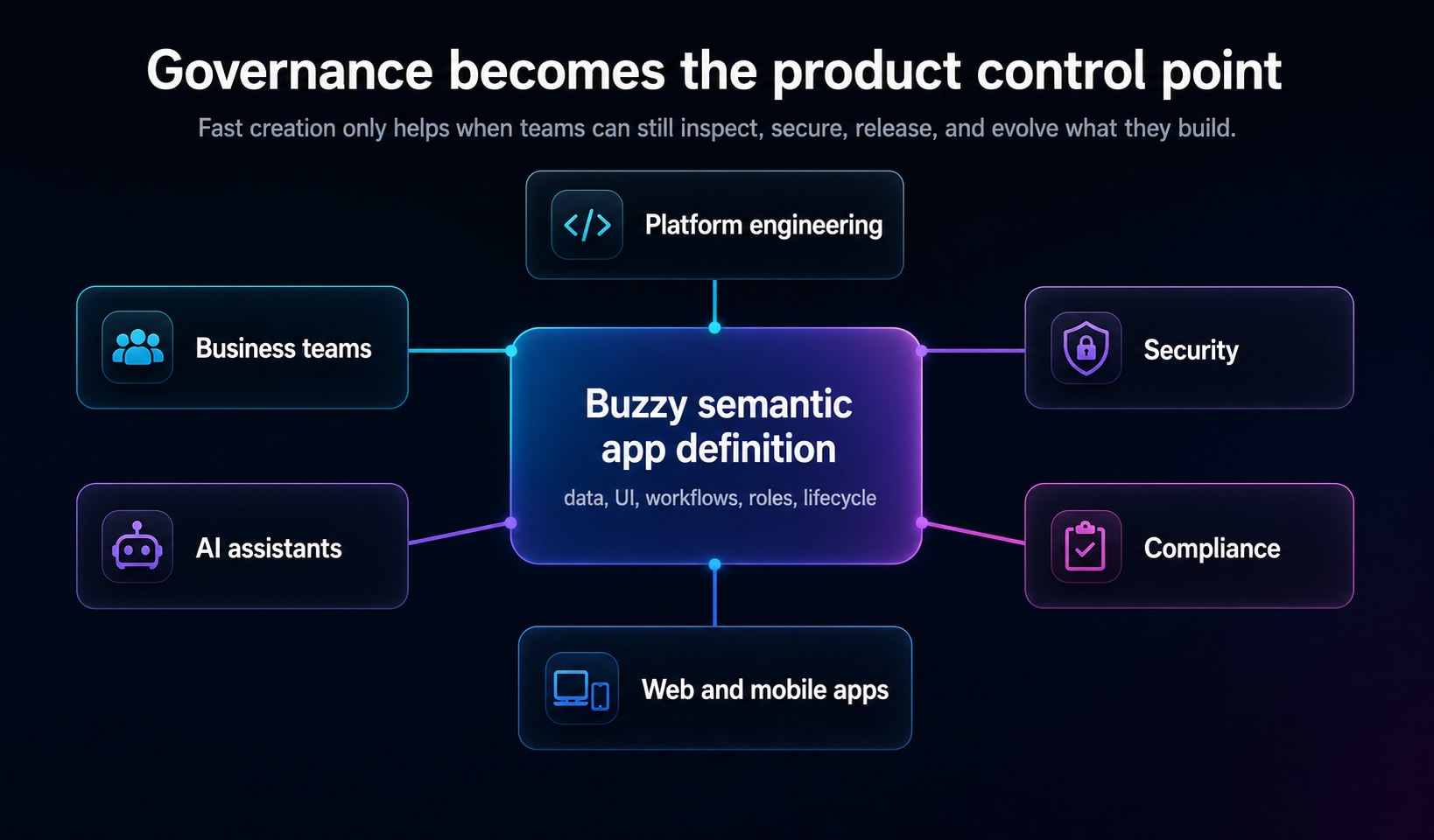
So, why Buzzy?
Buzzy is our answer to this problem.
Buzzy is an AI-native semantic application platform that turns prompts and Figma designs into production-ready web and mobile applications from a single governed system. Instead of generating a large bespoke codebase for every app, Buzzy generates a Semantic Application Definition: a structured model of the application’s data, workflows, business logic, security, privacy, and UI. That definition runs on a centrally managed core engine.
This is the key architectural idea.
Buzzy is not just trying to make code generation faster. It is trying to reduce the amount of custom code an organisation has to own in the first place.
The Buzzy model is designed so that platform-maintained code sits outside the customer’s day-to-day maintenance burden. Application-specific work is pushed into the semantic definition and controlled extension points, while the common runtime handles the shared machinery across web and native mobile.
That changes the maintenance equation.
With typical AI-generated code, every application may need its own architecture review, security review, compliance review, platform upgrade, patching process, and test strategy. With Buzzy, the goal is to centralise as much of that as possible in the core platform, so teams focus on the application definition, the workflow, the data, and the specific business logic that makes the app unique.
This is also why Buzzy is especially relevant for enterprises, mid-market companies, and agencies managing many client or internal applications. The first app matters. But the tenth app matters more. The fiftieth app is where architecture either pays you back or punishes you.
The proof is in the maintenance tail
One of the easiest mistakes in software is to judge a tool by how fast it gets you to version one.
That is understandable. Version one is visible. It is exciting. It is what everyone demos.
But enterprise software value is usually decided after version one.
Can you maintain it? Can you change it? Can you secure it? Can you upgrade it? Can you support it across platforms? Can you keep improving it without drowning in the codebase?
That is where Buzzy’s architecture is designed to matter.
For example, Swiftio used Buzzy to move from more than 100 Figma screens to a base web, iOS, and Android product in approximately four days, with custom code focused only on unique requirements and single-tenant deployment for compliance needs. The platform then supported continued evolution, including 30+ patches and three major releases in six weeks.
OneTap Feedback is another useful example. It has processed more than 1 million surveys in production and, according to Buzzy’s materials, avoided 350–650 developer hours on mobile maintenance alone while absorbing 20+ major React Native releases through Buzzy’s centrally managed architecture.
Those examples point to the bigger idea: the value is not just faster initial build. The value is reducing the ongoing burden of keeping applications alive.
AI-native development needs a new architecture
The current wave of AI tools is moving incredibly fast. Models are improving. Agents are getting more capable. Standards such as MCP are emerging. Interfaces are changing. What felt cutting edge six months ago can feel dated very quickly.
That is another reason semantic app architecture matters.
If your organisation bets everything on raw generated code, every shift in models, frameworks, UI patterns, mobile requirements, integrations, or agent standards can become another round of refactoring.
But if your application logic is captured in a semantic definition, and your runtime evolves underneath it, you have a more stable foundation. The interaction layer can change. The model can change. The interface can change. But the application definition remains the durable asset.
Buzzy’s own evolution reflects this: from Figma-to-app, to AI-assisted design, to direct prompt-to-app, and now toward AI-native application interaction through MCP and related standards, while preserving the same core semantic foundation.
That is the architecture I think enterprises need.
Not less AI.
Not slower AI.
Not more committees.
A better control point.
The future is not AI-generated code. It is AI-generated applications on governed runtimes.
AI coding is not going away. It is too useful.
But the first wave of AI coding has focused too much on the act of generating code and not enough on the lifecycle of owning applications.
For individuals and prototypes, that may be fine.
For enterprises, it is not enough.
Enterprises need to move fast, but they also need to know what they are running. They need governance. They need security. They need consistency. They need auditability. They need upgrade paths. They need to avoid creating fifty islands of code that nobody wants to maintain.
That is why I think every enterprise should build, buy, or adopt a semantic app builder.
Because the question is no longer: “Can AI generate this app?”
The question is: “Can we safely run, govern, maintain, and evolve every app AI helps us create?”
That is the problem Buzzy was built to solve.
About Buzzy
Buzzy is an AI-native semantic application platform for creating governed web and mobile applications from prompts or Figma designs. Instead of asking AI to generate and maintain a separate custom codebase for every application, Buzzy generates a Semantic Application Definition — a structured model of the app’s data, UI, workflows, business logic, security, privacy, and integrations — that runs on a centrally managed core engine.
The result is AI-speed application creation with a smaller custom-code surface, centralised maintenance, reusable governance patterns, and a clearer path from prototype to production.