Generated code ownership
Every app can bring its own architecture, dependencies, tests, deployment path, and security surface.
Why Buzzy?
Buzzy is built for teams that want prompt-to-app and Figma-to-app speed without turning every idea into another fragile codebase. The durable asset is a semantic application definition: the structured model of data, screens, workflows, permissions, integrations, tests, and release controls, running on Buzzy's managed engine.
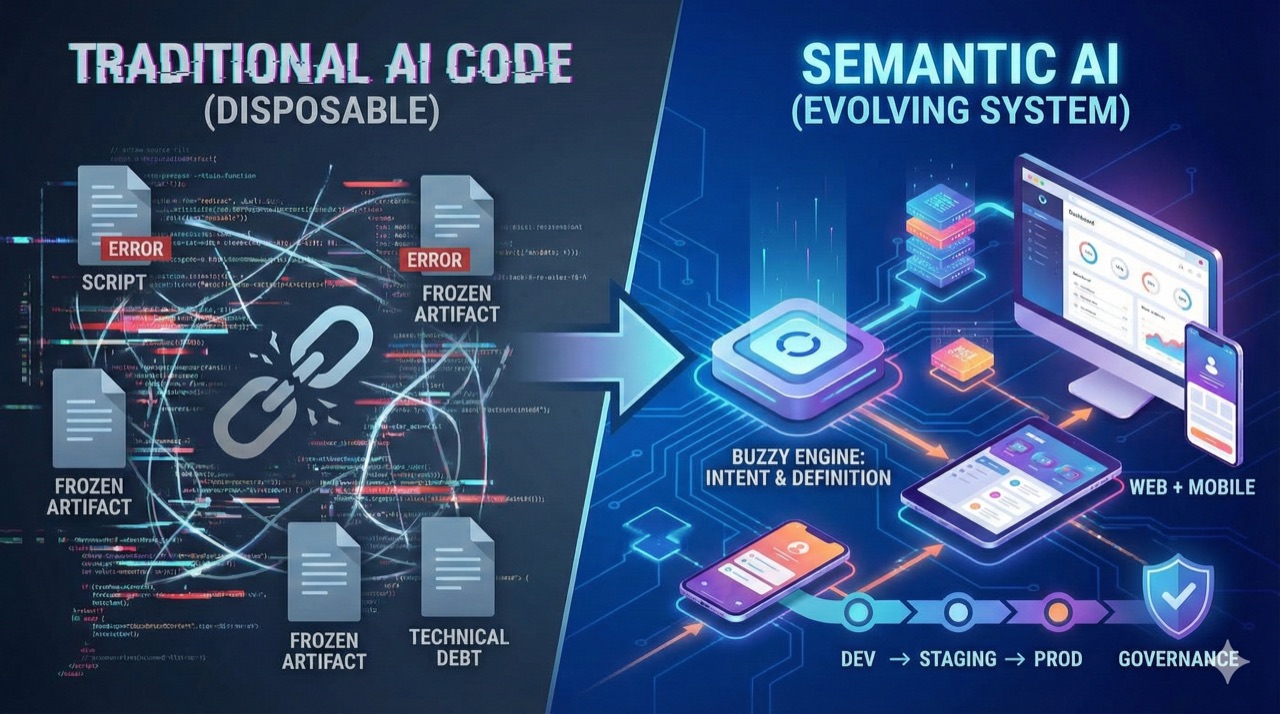
The problem
AI code generation has changed how fast software can appear. It has not removed the need to secure, test, document, patch, deploy, govern, and support the application after launch.
Every app can bring its own architecture, dependencies, tests, deployment path, and security surface.
One generated app is manageable. Fifty disconnected apps become an accidental software estate.
Security, privacy, access control, compliance, and release review need to be part of the app model early.
Standalone codebases age separately and miss shared runtime improvements unless someone refactors each one.
The difference
Buzzy separates application intent from implementation burden. Instead of asking AI to produce a bespoke application codebase for every project, Buzzy produces a semantic definition that the platform can render, secure, test, update, and publish across web and mobile channels.
That means business and technical teams can reason about the important parts of the app: data model, roles, private fields, user journeys, approval paths, integrations, app screens, APIs, agentic flows, and release state. The common runtime machinery remains centralized.
| Question | Raw AI-generated code | Buzzy semantic app platform |
|---|---|---|
| What is the durable artifact? | A source-code project your team must understand and maintain. | A semantic application definition running on a maintained engine. |
| Where does governance live? | Often in app-specific code, conventions, and after-the-fact review. | In explicit data, workflow, role, permission, testing, and release model settings. |
| How do apps improve over time? | Manual refactoring, framework upgrades, dependency updates, and patch cycles. | Platform improvements can benefit apps through the shared runtime. |
| Where does AI help? | Generating code that still needs to be reviewed, secured, and operated. | Generating and refining app intent, workflows, data models, screens, tests, and agentic flows. |
What changed
Buzzy is no longer just faster no-code. It is prompt-to-app, Figma-to-app, Builder MCP, Custom MCP, testing, release governance, and semantic app definitions as a foundation for AI-native software.
Prompt and Figma
Create apps from a prompt, a Figma file, a workflow brief, or an existing app pattern.
Builder MCP
MCP-enabled tools can inspect and adapt semantic app definitions instead of starting from a blank codebase.
Custom MCP
Buzzy apps can expose governed data, functions, and workflows to AI assistants through controlled interfaces.
Release control
Teams can separate development, staging, and production paths instead of treating every generated app as a one-off artifact.
Evidence
These are the current reference points behind the updated Buzzy positioning.
Whitepaper
A benchmark comparing raw AI-generated app code with Buzzy's semantic application platform, focused on maintenance, security, testing, and technical debt.
Download the whitepaperArchitecture
The strategic case for shifting from AI-generated codebases to semantic app definitions running on a governed runtime.
Read the articleBuilder MCP
A practical walkthrough showing how agentic tools can inspect and adapt Buzzy semantic app definitions instead of generating another standalone codebase.
See the workflowDelivery
Buzzy is designed for teams that need working web apps, mobile experiences, governed workflows, and AI assistant access without fragmenting the app into separate systems.
One semantic app definition supports browser workflows and native mobile delivery, helping teams avoid separate app logic and data silos for each channel.
Browser access for internal tools, portals, dashboards, and workflows.
Native mobile delivery for teams that need device-ready experiences.
Controlled app actions and data access for AI assistant workflows.
Buzzy supports managed cloud, private cloud, and on-premises deployment models for teams with different governance, privacy, and infrastructure requirements.
Managed hosting.
Isolated enterprise environments.
Deployment for strict internal network boundaries.
Audience
Build a portfolio of AI-assisted business apps without letting every app become a standalone maintenance burden.
Deliver client apps faster while leaving behind a governed system, not an opaque generated codebase.
Move from idea to working product while preserving an architecture that can keep evolving after the first version.